



Madrid’s first 200 metres will compress an entire Grand Prix into a few violent seconds. Five red lights will hang above the IFEMA grid. Engines will crack against concrete walls. Every driver will hold the clutch paddle at the bite point while the rear tyres search for grip beneath them. Then the lights will disappear.
A clean launch could send the pole-sitter into Turn 1 with control. Half a second of wheelspin could leave that same driver trapped between two rivals. There will be no time to recover, no long straight to rebuild momentum and no bank of previous race starts to study.
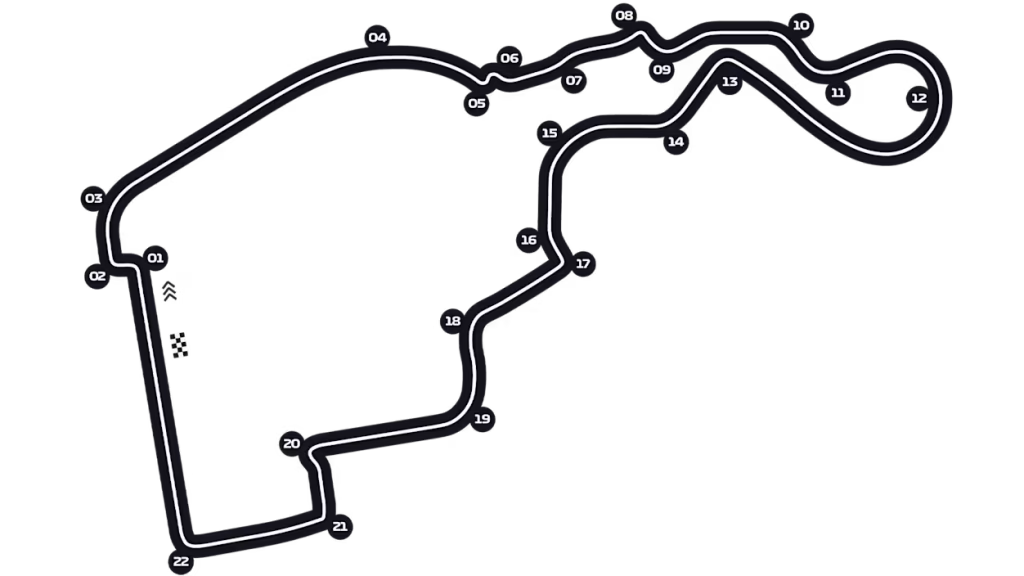
Madrid’s new 5.416-kilometre circuit debuts on September 13, 2026. Formula 1 will race for 57 laps around its 22 corners. Yet the decisive contest may arrive before the field reaches the first one.
The drivers know the geometry through simulators. They understand the estimated braking points and likely racing lines. None of them knows how the asphalt will feel when a full grid attacks it on cold tyres. That uncertainty gives Madrid its first great tension.
Nobody Has a Reliable Reference
Established circuits offer history. Teams arrive at Monza, Silverstone or Suzuka carrying years of clutch traces, onboard footage and tyre data. Engineers know which grid slots usually collect more rubber. Drivers remember how quickly the inside lane closes. Madrid offers theory.
A simulator can reproduce elevation, corner radius and surface roughness. It cannot recreate the exact grip level at the moment the lights go out. Support races may improve one side of the grid. Wind could scatter dust across another. Shadows from the IFEMA buildings may cool patches of asphalt before the start.
Those differences sound minor until the full grid releases its clutches together. Friday practice will therefore shape Sunday’s opening seconds. Teams will compare launch data from both sides of the track. Drivers will test how aggressively they can release the clutch without spinning the rear tyres. Engineers will study throttle traces, wheel speed and acceleration through the first few gears.
Even then, the target may move. New asphalt changes rapidly as rubber settles into the racing line. A grid slot that feels clean on Friday afternoon may offer different grip two days later. The driver who adapts fastest could gain more from observation than another gains from raw qualifying speed.
The Launch Demands Finesse
A Formula 1 start begins with touch, not bravery. The driver holds the clutch at a carefully prepared bite point and balances the throttle against the available grip. Release the paddle too slowly, and the car hesitates. Let it snap back too quickly, and the rear tyres flare into wheelspin.
Either error costs metres immediately. Madrid makes those mistakes harder to hide because Turn 1 arrives so quickly. A poor launch from pole could invite attacks from both sides before the driver reaches fourth gear. Someone starting on the second row may need only a cleaner reaction to draw alongside.
The new generation of power units adds another technical layer.
Electrical Power Changes the First Phase
Under the 2026 regulations, Formula 1 moved toward a near-even split between combustion and electrical power. The MGU-K can now deliver up to 350 kilowatts, almost three times the previous output, while the MGU-H has disappeared.
That extra electrical contribution gives teams enormous torque to manage. Engineers must deliver the power smoothly enough for the rear tyres to accept it. The driver still provides the final adjustment through the clutch paddle and throttle. Raw output means little when the tyres cannot transfer it to the road.
The FIA also introduced a start-safety measure in April 2026 after concerns about cars accelerating too slowly from the grid. The system monitors a car after clutch release. When it detects abnormally weak acceleration, it can trigger automatic MGU-K deployment and warning lights to protect the vulnerable car.
That intervention reduces danger. It does not rescue the driver’s race. A car that bogs down will still lose positions. At IFEMA, it may also force the rows behind to split suddenly across the straight. One weak launch could create three separate braking lines into Turn 1.
Turn 1 Will Reward Nerve and Restraint
The run from the start line to the first corner measures just over 200 metres. That distance gives drivers enough time to reach high speed, but not enough to reconsider a bad decision.
Turn 1 measures 15 metres wide, and the extra space will encourage ambition. A front-row driver may cover the inside before the field gains momentum. Someone behind could aim for the middle and trust that the gap remains open. Farther back, others will react to movements they can barely see through rear wings, tyre smoke and flashing rain lights.
Cockpit visibility will intensify the risk. High sidewalls and the halo create blind spots around the rear wheels. Mirrors show only fragments when a rival pulls alongside. A late-braking car can disappear from view at the exact moment the driver begins turning.
Once the field leaves the grid, judgment matters more than reaction time. Brake too early, and a rival sweeps around the outside. Attack too late, and the front tyres lock before the apex. Hold the middle lane, and both exits may close.
Cold tyres make every option less predictable. The front axle will resist rotation. Rear grip may disappear as drivers downshift and turn. With heavy fuel aboard, the cars will feel slower to stop and less willing to change direction.
Madrid’s first corner may look spacious on television. From the cockpit, it will feel crowded instantly.
Winning Turn 1 May Not Be Enough
The opening sequence does not end at the first apex. Turn 2 follows quickly and tightens the field again. A driver who dives deep into Turn 1 may compromise the next corner. Another can concede the first apex, cut back underneath and straighten the steering wheel earlier.
That exit carries the field toward Hortaleza, the fast right-hander at Turn 3. From there, the cars launch onto an 837-metre straight, the longest full-throttle section of the circuit.
A driver who protects position too aggressively at Turn 1 could become vulnerable seconds later. Battery deployment will shape that second fight. The attacker must decide whether to spend electrical energy immediately or save it for the braking zone at the end of the straight. The defender must position the car without destroying the exit or overheating the rear tyres.
This sequence rewards drivers who think two corners ahead. The spectacular move may happen under braking. The smarter move may begin earlier, with a patient line and cleaner acceleration.
Smaller Cars Will Still Punish Contact
Formula 1 designed the 2026 cars to feel lighter and more agile. The minimum weight dropped to 768 kilograms. The wheelbase shortened by 200 millimetres, while the body became 100 millimetres narrower.
Pirelli also reduced tyre width by 25 millimetres at the front and 30 millimetres at the rear. Those changes should make the cars easier to place in close combat. They do not remove the danger of the opening lap.
A narrower car may fit into a gap that last year’s machine could not attack. The smaller tyre contact patch, however, gives the driver less rubber to manage during acceleration and braking. Cold tyres will amplify that weakness.
Aerodynamics also provide limited help during the first metres. The floor and wings generate more grip as speed rises. At the instant of launch, the rear tyres and suspension must carry most of the load.
That makes Madrid’s opening sprint a revealing technical test. Teams with smooth torque delivery should accelerate more cleanly. Cars that protect their rear tyres may hold traction through the first gear changes. Drivers who understand the clutch quickly can turn those strengths into track position. Anyone who guesses wrong may spend the afternoon recovering.
A Clean Launch Changes the Strategy
The benefits of a strong start extend far beyond Turn 1. A driver who reaches clean air can protect the tyres and control the pace. Brake temperatures become easier to manage. The pit wall can follow its preferred strategy rather than reacting to traffic.
A poor launch creates the opposite problem. Following another car through the faster sections can raise tyre temperatures and reduce front grip. Attacking down the long straight consumes electrical energy. Failed overtaking attempts may force the driver into an early stop or an unwanted tyre offset.
Madrid should provide passing opportunities. Its long straight and heavy braking zones invite attacks. None of those moves will come free. Track position remains the most valuable currency in Formula 1, and the opening 200 metres offer the cheapest chance to earn it.
Championship pressure will sharpen every decision. Madrid follows Monza and closes the European leg of the season. By mid-September, contenders will understand exactly what each lost point means.
That reality can change a driver’s risk calculation. Someone fighting for the title may defend harder than usual. A midfield driver chasing a rare podium may attack a gap that barely exists. The first Spanish Grand Prix at IFEMA could produce its defining moment before strategy begins.
Madrid’s First Memory Will Come at Full Throttle
La Monumental will become the circuit’s visual landmark. The 550-metre banked corner reaches a gradient of 24 percent and should provide the weekend’s most dramatic television images. Still, Madrid may establish its identity somewhere less glamorous.
The first start will reveal which grid side holds more grip. It will show whether Turn 1 rewards the inside line or leaves room for an outside attack. Drivers will discover how quickly the field compresses before Turn 2 and how vulnerable the leader becomes toward Hortaleza.
Future teams will study those answers. They will replay onboard footage, compare launch traces and arrive with established braking references. Rookies will know where the gaps usually close. Engineers will understand how the surface changes between Friday and Sunday.
The inaugural field receives none of that comfort. When the lights go out, every driver will trust a clutch map, a handful of practice starts and their own instincts. Electrical power will surge through the rear axle. Cold tyres will claw at unfamiliar asphalt. The full field will rush toward a braking zone wide enough to invite hope but too narrow to satisfy everyone.
Forget the remaining 57 laps for a moment. Madrid’s first 200 metres will create the circuit’s first piece of history.
READ MORE: How Charles Leclerc Can Gain Time With Qualifying Pace at Madrid
FAQs
How long is the run from the Madrid grid to Turn 1?
Drivers face just over 200 metres between the start line and Turn 1, leaving almost no time to recover from a poor launch.
Why will the Spanish Grand Prix start be so difficult?
Cold tyres, unfamiliar asphalt and limited real-world data will make grip difficult to predict when the lights go out.
How will the 2026 power units affect the Madrid start?
The stronger electrical system delivers considerable torque. Teams must release that power smoothly enough to avoid hesitation or rear-wheel spin.
What happens after Madrid’s first corner?
Turn 2 quickly compresses the field again before Hortaleza leads onto the circuit’s 837-metre straight.
When is the 2026 Spanish Grand Prix in Madrid?
The Madrid race takes place on September 13, 2026, with practice beginning on September 11.

Exploring sport through timely updates, informed insights, compelling stories, and wider discussion.
