


Dirty-air control at Monza begins at more than 350 kilometres per hour, with the steering wheel alive in a driver’s hands and the braking boards arriving like fence posts in a storm. A pursuing car surges into the leader’s slipstream along the main straight. The engine note climbs. Distance collapses. Then the attacker pulls sideways for the Variante del Rettifilo, and the front axle suddenly feels lighter.
That change lasts only a heartbeat. It can still decide the race.
Monza’s carbon brakes can glow beyond 1,000°C under heavy braking, while the fastest cars have recently crossed the speed trap above 360 kph. Yet the danger does not come from speed alone. It comes from asking a low-downforce car to brake, turn, and change aerodynamic state while the air around it churns like exhaust smoke.
Raw velocity creates the chance. Mastering the turbulent wake determines whether that chance becomes a pass, a lock-up, or a trip across the escape road.
Monza turns a small aero loss into a crisis
The FIA built the 2026 regulations to improve close racing. Its projections suggested a following car could retain roughly 90% of its downforce at 20 meters, compared with about 70% near the end of the previous rules cycle. That represents a major step. At Monza, though, even a smaller loss can hurt because teams arrive with wings trimmed close to the minimum.
A high-downforce circuit gives the front axle more aerodynamic margin. Monza offers almost none. The car already feels nervous under braking, light over the curbs, and reluctant to change direction when the platform moves. Take another slice of load away, and the driver starts negotiating with the steering wheel.
The final 2026 terminology also matters. Formula 1 now calls the high-downforce setting Corner Mode and the low-drag configuration Straight Mode. Earlier development labels such as Z-mode and X-mode have fallen out of the official public vocabulary. Likewise, Overtake Mode replaced the working title Manual Override Mode.
That attacking aid changes the electrical power profile for a driver who qualifies within one second at the detection point. It can also permit up to 0.5 megajoules of additional recharge across the next lap. The system extends an attack. It does not create front grip.
To survive Monza’s disturbed air, drivers must choose exactly where to accept instability and where to protect the tires. Spend too much energy before Turn 1, and the car may lack a second strike toward the Variante della Roggia. Sit too far back through Curva Grande, and the one-second window may disappear.
The Variante del Rettifilo exposes the trap
A pursuing driver accelerates into the vacuum behind the leader, and gains speed almost for free. In 2025, the official speed trap recorded 364.1 kph during the Italian Grand Prix weekend. That number gives the approach to Rettifilo its violence, but the crucial moment comes when the attacker leaves the tow.
Clean air does not return like a light switch. The car crosses from the leader’s turbulent wake into a different pressure field while the driver stamps on the brake pedal. At the same time, the front wing must recover load, the floor must stabilise, and both active wings must return from Straight Mode to Corner Mode.
The cockpit becomes brutally busy. Inside it, the driver checks the closing rate, watches the leader’s defensive move, catches the car’s first twitch, and aims between raised curbs that punish indecision. Carbon discs bite at four-figure temperatures. Belts crush the shoulders. The steering goes light, then suddenly heavy as the front tires reconnect with the road.
One missed judgment can lock the inside tire and ruin a set of rubber on the spot. Another can send the car bouncing across the runoff, surrendering the position and inviting a penalty.
This is where wake management stops sounding like an engineering phrase. It becomes survival.
The leader fights with the air behind
Charles Leclerc’s 2019 victory remains the clearest modern lesson. Lewis Hamilton spent much of the race close enough to attack, rarely allowing the Ferrari more than a couple of seconds of breathing room. Leclerc defended at Curva Grande and the Variante della Roggia, placing his car where Hamilton had to choose between dirty air, the edge of the track, and a shrinking braking zone.
Hamilton later explained that prolonged close following pushed his tires toward the cliff. Leclerc, meanwhile, fought front locking before the rear grip began to fade. Their duel showed how defence at Monza stretches beyond covering the inside line. The leader can shape the attacker’s airflow, corner entry, and tire life for lap after lap.
That duel’s mechanics change under the 2026 rules, but they do not erase the psychological warfare. Straight Mode now helps every driver cut drag on approved sections. Overtake Mode gives the pursuer another electrical weapon. Still, the leader controls the first move.
A smart defender exits the Lesmos cleanly, positions the car to foul the rival’s airflow, and forces the attacker to spend battery earlier than planned. Move too soon, though, and the outside lane opens. Defend too aggressively, and both cars can arrive at Roggia with no clean line left.
The battle through turbulent air therefore belongs to the car in front as much as the one behind. Ideally, the pursuer stays close enough to suffer, but never close enough to complete the pass.
Ascari reveals the thermal damage
The Variante Ascari exposes everything a driver tried to hide through the first half of the lap. Its left-right-left sequence arrives after another long burst of acceleration, and the car must attack the curbs without losing the rear. In clean air, the rhythm feels sharp and committed. Behind another car, the front tires can smear across the asphalt before the rear snaps under the second change of direction.
Long straights complicate the temperature picture. Tire surfaces can cool while the internal carcass and brakes retain heat. Then dirty air forces extra steering input at corner entry. The front tires scrub. Rear temperatures rise as the driver asks for more traction to repair a compromised line.
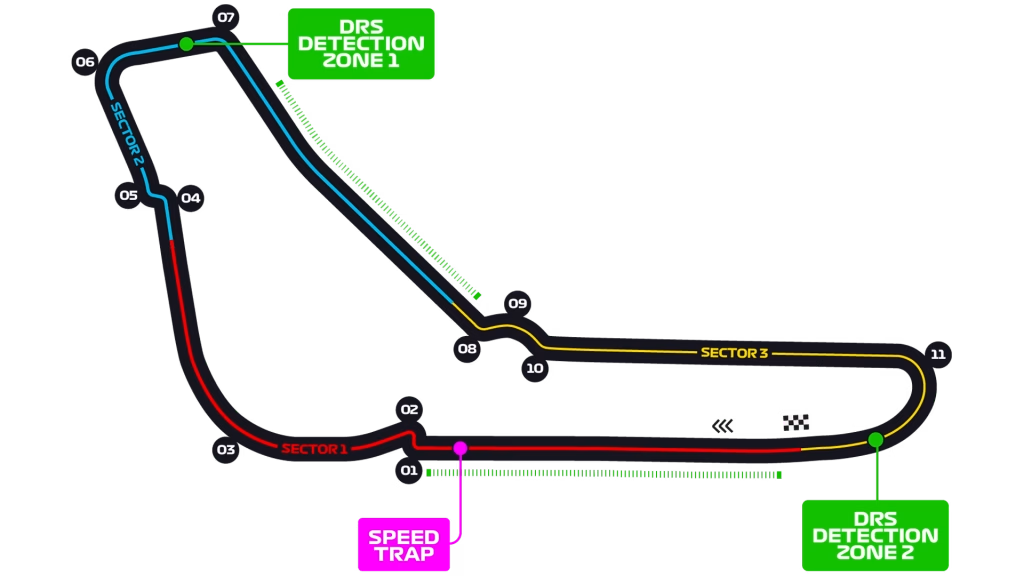
Ascari turns that imbalance into lap time. Miss the first apex by half a meter, and the car arrives late for the right-hander. Climb the curb awkwardly, and the floor loses stability. Hesitate at the final left, and the exit toward Curva Alboreto disappears.
A driver may survive the sequence once. Repeating it for ten laps creates a different problem. Tiny slides roughen the tire surface, brake temperatures creep upward, and the steering corrections grow larger. The television picture can look calm while the cockpit fills with warning signs.
Handling Monza’s wake means recognising that spiral early. Elite drivers alter their line before the understeer arrives. They leave a fraction more space at corner entry, square the exit, and protect the tire that must carry the next braking load.
The pit wall can rescue the attack
Engineers cannot feel the front axle go numb, but the data tells its own story. Steering angle rises. Minimum corner speed falls. Brake temperatures climb. The driver begins losing time in places where the stopwatch had looked healthy five laps earlier.
A useful radio message must cut through the noise. The driver needs the gap ahead, the energy target, and the tire warning. A lecture on airflow will not help at 350 kph.
Strategy then becomes part of the aerodynamic fight. An early stop can buy more than fresh rubber. It can release a driver into clean air, restore the car’s balance, and turn one fast out-lap into an undercut. Staying out may preserve track position, but another five laps in a rival’s wake can damage the tires enough to erase that advantage.
Energy use adds another layer. Overtake Mode can be spent in one concentrated attack or divided across the lap. Boost Mode, available as the driver’s own deployment tool, can support an attack or defend against one. The pit wall must decide whether to target Rettifilo, build pressure toward Roggia, or save enough electrical power to punish a weak exit from Ascari.
No algorithm can make that call alone. The engineer sees the traces. Grip reaches the driver through the steering wheel. Together, they must judge whether the next lunge offers a real opening or only another lap of tire damage.
The winner will know when to stop attacking
Monza celebrates commitment, but blind aggression rarely survives an entire Grand Prix. Straight-line speed can still end in lost front grip at Rettifilo. Relentless pressure can cook the tires behind a slower car. A defender who wins five braking zones may lose the sixth because the battery ran dry.
That tension gives dirty-air control at Monza its real importance. Drivers must attack without chasing every half-chance. They must feel when the wake has weakened the front axle, when the tire surface has slipped out of its window, and when one more lap behind the same rival will cost more than dropping back.
The decisive move may begin at Lesmo 2, not Turn 1. A cleaner exit can preserve front temperature through Ascari. Better battery discipline can create a stronger run through Curva Alboreto. One patient lap can produce the closing speed that three desperate lunges failed to find.
At Monza, the margin between control and chaos arrives frighteningly fast. Misread the wake, and the car spears across the Rettifilo runoff. Overheat the fronts, and Ascari becomes a sequence of corrections rather than an attack. Lose rear confidence at Curva Alboreto, and the podium vanishes down the straight.
By the time the checkered flag falls, horsepower, low drag, and bravery will have played their part. Yet the Italian Grand Prix may already have been settled in the invisible air before its hardest braking zones.
The driver who masters Monza’s disturbed wake will keep the front tires alive, release electrical power at the decisive instant, and launch the final attack with a car still underneath them. At the Temple of Speed, that split-second command separates victory from gravel, tire smoke, and a podium disappearing at more than 350 kilometres per hour.
READ MORE: How Pierre Gasly Can Gain Time With Undercut Timing at Monza
FAQs
Why does dirty air matter so much at Monza?
Monza’s low-downforce setups leave little aerodynamic margin. A pursuing car can lose front grip just as its driver reaches the circuit’s hardest braking zones.
What is the difference between a slipstream and dirty air?
A slipstream reduces drag and increases straight-line speed. Dirty air disrupts airflow over the following car and reduces its cornering downforce.
How does Overtake Mode work in Formula 1’s 2026 rules?
A driver within one second at the detection point can access extra recharge and a stronger electrical power profile on the following lap.
Why is the Variante del Rettifilo so difficult?
Drivers arrive above 350 kph, leave the slipstream and brake heavily while the front wing and floor recover stable airflow.
Can pit strategy reduce the effect of dirty air?
Yes. An early stop can release a driver into clean air, protect the tires and create a faster out-lap for an undercut.

Exploring sport through timely updates, informed insights, compelling stories, and wider discussion.
