


The climb to Turn 1 at the Circuit of The Americas feels like a blind leap of faith. Max Verstappen fires uphill, the horizon drops away, and the braking zone arrives before the car has fully settled. Texas wind pushes at the chassis while the front tires search for bite. Behind them, the rear axle cannot blink.
That combination makes Austin an intriguing test of Verstappen’s qualifying pace in 2026. Through 11 Grands Prix, the four-time world champion has scored 109 points without a win or a Grand Prix pole. Formula 1’s official statistics also list three DNFs and four podiums, helping explain a total that looks startling beside his recent standards.
Austin offers evidence that Verstappen can make this circuit work for him. In the 2025 Grand Prix qualifying, he produced a 1:32.510 to beat Lando Norris by 0.291 seconds. That was the proper Saturday qualifying session, not Sprint Qualifying. One year later, finding that kind of lap will demand much more than late braking.
Austin Turns Tire Preparation Into the First Qualifying Test
COTA stretches for 5.513 kilometers, but the circuit rarely asks the car the same question twice. The opening sector rewards high-speed direction changes. Turn 11 feeds a long acceleration zone, while the technical sequence from Turns 13 through 15 leads into the loaded right-hand sweep before Turn 19.
That variety creates both opportunity and danger. Red Bull must prepare the tires before the lap without spending their best grip too early.
Pirelli reduced the 2026 front tire width by 25 millimeters and the rear by 30 millimeters compared with the previous generation. The company also reduced the overall diameter while retaining 18-inch wheels. Those dimensions belong to Pirelli’s finalized 2026 specification rather than an early concept from the regulation-development process.
The change matters on the out-lap. Verstappen wants enough front temperature to attack the first braking zone, but aggressive preparation carries a cost. Heat the rubber too hard, and the tire may lose some of its sharpest response deeper into the lap. Arrive too cautiously, and Turn 1 becomes damage limitation.
The stopwatch starts judging him before he crosses the line.
Turn 1 Rewards Control More Than Braking Heroics
COTA’s opening corner tempts drivers into heroics. The track rises sharply toward a wide left-hander, creating several possible lines and a braking zone that visually compresses as the car climbs.
Verstappen does not need to win the entire lap there. Instead, he needs a front axle that reacts cleanly when he releases the brake and asks the car to rotate. A reluctant front end forces extra steering lock, while a nervous rear can punish an aggressive brake release even more severely.
The best version of Turn 1 looks almost uneventful: brake hard, rotate once, get downhill. That clean exit matters because Turn 2 immediately points the car toward COTA’s fastest sequence. Any correction near the apex compromises the approach to the esses, where the RB22 faces its first major examination.
The Esses Will Expose Every RB22 Balance Problem
Turns 3 through 6 do not allow a driver to hide balance problems. Verstappen throws the car left, right, then left again while aerodynamic load changes almost continuously.
Each steering input affects the platform required for the next one. A front end that responds half a beat late forces him to alter his line, while rear instability strips away commitment.
When Verstappen trusts the car, his minimum speed can become devastating. A nervous rear end produces something very different: micro-lifts on the throttle, tiny steering corrections, and fractions of lost speed that spectators may never notice. The timing screens notice everything.
That problem appeared in Austin before. During the 2025 post-qualifying press conference, Verstappen explained that a strong tailwind through the esses reduced downforce and made the Red Bull move around more. The changing wind limited how aggressively he could commit through Sector 1, even on a weekend when he still claimed pole.
Place the 2026 RB22 into the same environment,t and Red Bull’s development work becomes much more than a technical footnote.
Red Bull’s Upgrades Face Their Hardest Test at COTA
The team arrived at the Austrian Grand Prix with one of its biggest 2026 upgrade packages. Formula 1’s technical analysis listed revisions to the floor, rear suspension, rear cornerer, and rear wing, alongside changes around the exhaust.
Engineers also altered the floorboard profiles to improve airflow conditioning. Those details matter because COTA’s esses punish a car whenever aerodynamic balance shifts unpredictably during rapid direction changes.
Better control of airflow beneath and around the floor can help deliver a more consistent load. Suspension behavior then determines how stable that aerodynamic platform remains while Verstappen attacks kerbs, steering inputs, and elevation changes.
The upgrades have not turned the RB22 into an effortless qualifying car. Verstappen crashed on his final qualifying attempt in Austria and started fifth. Hours later, he drove to second and finished only 1.611 seconds behind George Russell, while describing the car as being in a good operating window for part of the race.
That contrast captures Red Bull’s problem. The raw speed improved, but extracting every tenth remained difficult.
For Verstappen’s Austin qualifying challenge, Red Bull needs less volatility rather than simply more peak downforce. He must know what the rear axle will do before committing to the first flick through the esses. Confidence lets him attack; uncertainty forces him to leave margin.
Turn 11 Can Decide the Entire Back Straight
After COTA’s fast opening sector, the rhythm changes. Turn 11 looks simple beside the esses, but its exit can quietly decide a large chunk of lap time because the corner launches the car toward the back straight.
A poor rotation there does not just cost Verstappen on entry. It bleeds speed all the way down one of COTA’s longest full-throttle sections.
Patience becomes valuable. Rather than forcing the nose toward the apex, Verstappen needs the RB22 rotated early enough to straighten the car for acceleration. Wheelspin wastes the work, and extra steering angle does the same.
This is where Verstappen’s qualifying aggression has to become calculated rather than spectacular. He can attack the brake pedal, but the priority remains getting the car pointed cleanly toward the straight.
Turn 12 then presents the opposite problem. Heavy braking asks the rear axle to stay calm while Verstappen transfers load forward. Any instability can force him to release pressure earlier or delay rotation. Neither mistake looks dramatic, but both cost time.
The Final Sector Punishes Drivers Who Chase the Lap
Austin becomes awkward again after the back straight. Formula 1’s circuit analysis identifies Turns 13 through 15 as one of COTA’s trickiest sequences because drivers struggle to find a clean rhythm through the complex.
Then comes the long right-hand section through Turns 16 to 18, followed by the fast approach to Turn 19.
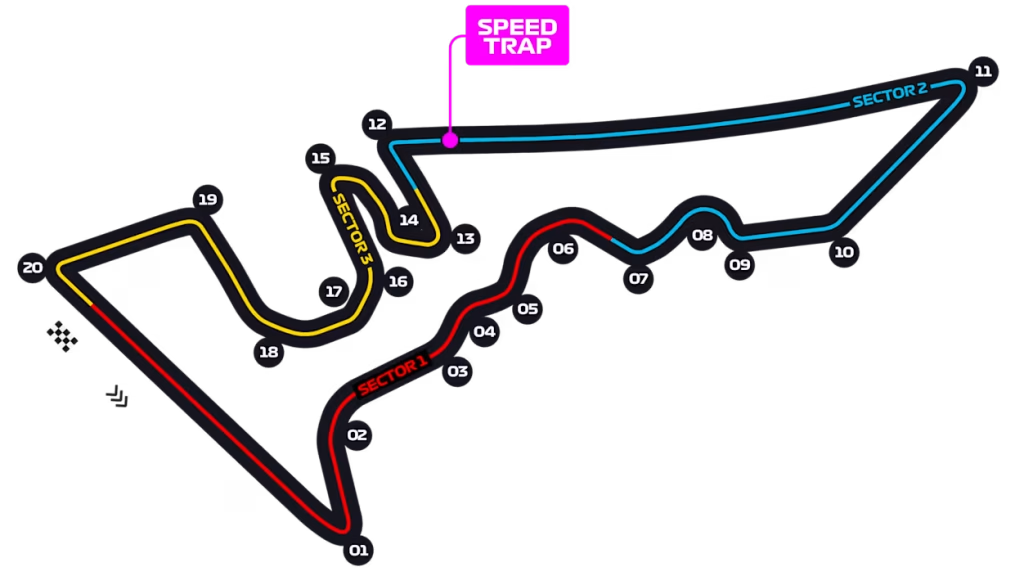
This part of the lap can trap an impatient driver. By now, Verstappen knows whether the lap feels quick. His steering-wheel delta tells part of the story, while the tires have already endured Turn 1, the esses, heavy braking, and several hard acceleration phases.
He cannot start demanding a grip that no longer exists.
Through the long right-hander, confidence matters more than theatrics. A settled RB22 allows Verstappen to keep the throttle committed and carry speed across the entire loaded sequence. Rear movement changes the equation instantly.
One small correction scrubs speed. Another shifts the line. The following corner then arrives from the wrong angle. That is how a lap unravels without one obvious mistake.
Turn 19 provides the final temptation. The pressure to push grows when the delta looks competitive, but Verstappen still needs enough margin to keep the car legal and pointed toward the final corner. At Austin, the great qualifying laps often look violent from the outside. Inside the cockpit, they depend on restraint.
Verstappen’s 2025 Pole Provides the Blueprint
The most useful clue for 2026 comes from October 2025.
Verstappen topped Q1 with a 1:33.207, then improved to 1:32.701 in Q2. His first Q3 lap lowered the benchmark again to 1:32.510. Nobody beat it.
More importantly, he never completed his planned second Q3 attempt. Traffic on the out-lap left Verstappen short of the line by a few seconds after several cars ahead opened unusually large gaps. His first effort had to survive, and it did.
That session demonstrated something crucial about Verstappen’s qualifying style. He does not always need three escalating attempts before producing his best work. Give him confidence early enough, and he can put a decisive lap on the board before everyone else has finished building toward theirs.
Red Bull needs that version again.
The 2026 car may never give him the dominance he enjoyed during the championship years, but Austin does not demand a perfect machine everywhere. It demands a car that communicates clearly as the circuit changes character.
Austin Will Reveal How Far Red Bull Has Really Come
The 2026 United States Grand Prix runs from October 23 through October 25, giving Red Bull several more races to understand and develop the RB22 before Formula 1 reaches Texas.
Austin should expose whether that progress has substance.
A fast first sector would suggest Red Bull has given Verstappen greater confidence in high-speed direction changes. Strong exits from Turns 11 and 20 would point toward better traction and mechanical stability. Clean commitment through the long right-hand section would say even more about the aerodynamic platform beneath him.
No single corner will explain Verstappen’s qualifying pace at Austin. That is what makes COTA such an honest test.
Red Bull cannot mask a weak front end through the esses. Verstappen cannot compensate forever for an unpredictable rear. Engineers cannot recover a poor out-lap once he reaches Turn 1 with the tires outside their best window. Everything connects.
For a driver sitting on 109 points, without a Grand Prix win or pole after 11 races, Austin offers more than another Saturday qualifying session. It provides a chance to measure how much of Verstappen’s familiar one-lap edge has survived Formula 1’s new technical era.
That answer could arrive in less than 93 seconds. Verstappen will crest Turn 1 and drop downhill, asking the RB22 to bite through the esses instead of sliding across them. He will need one clean rotation at Turn 11, a stable car under the braking load at Turn 12, and enough confidence to hold speed through COTA’s long final-sector sweep. No corner requires a miracle. Every corner requires certainty, and if Red Bull gives him that certainty for one complete Q3 lap, the stopwatch may finally start looking familiar again.
READ MORE: Why Tire Warm-Up Could Decide the United States Grand Prix
FAQs
How fast was Max Verstappen in the 2025 qualifying at Austin?
Verstappen took pole with a 1:32.510 lap. He beat Lando Norris by 0.291 seconds.
Why are the COTA esses so important for Max Verstappen?
Turns 3 through 6 demand quick direction changes and a stable rear end. Small corrections can cost valuable qualifying time.
How could the 2026 F1 tires affect Verstappen at Austin?
The 2026 tires are narrower than the previous generation. Red Bull must get their temperatures right before Verstappen begins his qualifying lap.
When is the 2026 United States Grand Prix?
The Austin race weekend runs October 23–25, 2026, at the Circuit of The Americas.
Has Max Verstappen taken a Grand Prix pole in 2026?
No. Through the first 11 Grands Prix, Verstappen has no Grand Prix poles and sits on 109 championship points.

