


Lando Norris’s qualifying pace at Baku will be decided in moments when the speed suddenly vanishes and concrete fills his visor. He can spend much of the final sector flat-out, engine screaming beside the Caspian Sea, then arrive at Turn 1 with front tyres far colder than they were half a minute earlier. That first hard hit of the brake pedal tells him whether the lap still has a future.
Baku offers almost no comfortable middle ground. Give away a metre under braking and the stopwatch notices. Chase one metre too many and the wall might end qualifying altogether.
For Norris, that tension carries more weight in 2026. He entered the summer break fifth in the championship with 128 points, 91 behind Kimi Antonelli, but his recent form has changed the mood around McLaren. Hungary brought his first Grand Prix pole of the season with a 1:17.207, only 0.012 seconds clear of Lewis Hamilton.
Now Baku asks a less forgiving question. Can Norris turn that new Saturday confidence into a clean lap at a circuit that has already punished him twice?
Baku has already made Norris pay on Saturday
Norris does not need anyone to explain what a bad qualifying session can cost here.
In 2024, his final Q1 attempt disappeared behind yellow flags, and he failed to progress. The reshuffled grid eventually left him 15th, while teammate Oscar Piastri started alongside pole-sitter Charles Leclerc on the front row.
Hours later, the contrast became painful. Piastri won the Azerbaijan Grand Prix. Norris produced an excellent recovery to finish fourth, even passing title rival Max Verstappen, but the race had effectively begun with the two McLarens living in different worlds. The car had winning speed. Norris spent Sunday recovering from Saturday.
One year later, Baku found another way to hurt him. Norris topped FP3 and entered qualifying as a genuine pole contender, but a chaotic session produced six red flags. His decisive Q3 lap became scrappy; he clipped the wall at Turn 15 and finished seventh while Verstappen took pole. McLaren team principal Andrea Stella later said Norris had been on course for a much stronger position before that contact.
Those two weekends create the baseline for 2026. The challenge has not changed, but Norris has. He returns as the reigning world champion, with greater authority inside the cockpit and a McLaren that has started turning Sunday speed into serious Saturday performance.
Baku no longer looks like a damage-limitation exercise. It looks like a test of whether Norris has finally learned how to seize the circuit before it seizes him.
The 2026 version of Norris arrives with real one-lap momentum
McLaren’s early-season problem was easy to spot. The car could look dangerous across a stint without carrying the same threat into the final minutes of Q3.
At Silverstone, Norris finished third in the Sprint but qualified only sixth for the Grand Prix. Austria brought another sixth-place qualifying result after promising practice speed. That disconnect made the next two races significant.
At Spa, Norris produced a 1:44.801 and qualified third. More importantly, he called the lap one of the best he had driven, even though a power-unit penalty meant he would start farther back.
Then came Budapest.
Norris snatched pole from Hamilton by twelve thousandths of a second and converted it into victory. The result mattered, but the sequence mattered more. For once, McLaren did not need Norris to rescue an imperfect Saturday through tyre management and race pace. He controlled the weekend from the front.
Norris’s qualifying pace at Baku requires a different kind of confidence. Budapest rewards rhythm and front-end precision. Baku asks him to combine low-speed rotation, enormous braking commitments and straight-line efficiency in the same lap.
That brings McLaren to the ugliest compromise on the circuit.
McLaren cannot build the perfect Baku setup
The Baku City Circuit stretches 6.003 kilometres, but its length hides the real problem. One part of the lap begs engineers for downforce. Another punishes them for carrying it.
McLaren trackside expert Henry Fidler explained that dilemma before the 2025 Azerbaijan Grand Prix. A higher-downforce rear wing could produce more pure qualifying lap time, but the race demanded another calculation.
As Fidler put it, “it can be a very painful Sunday in Azerbaijan if you have too much drag on the car.”
That sentence gets to the heart of Norris’s challenge. Add wing, and the McLaren becomes friendlier through Baku’s slow, narrow middle sector. Norris can lean harder on the rear, attack changes of direction and carry more confidence beside the Old City walls.
Trim the car too aggressively and that security disappears. A lower-drag package gives him precious straight-line speed during Baku’s 2.2-kilometre full-throttle section, the longest on the Formula 1 calendar. The cost arrives when he needs the car to rotate cleanly at lower speeds.
No setup wins everywhere. The fastest version of the MCL40 will be the one Norris can trust closest to the limit.
Cold tyres turn Turn 1 into the first real test
The lap starts punishing Norris before he reaches the braking zone.
Pirelli data from Baku has shown the front tyres can lose roughly 40 degrees Celsius during the long flat-out run toward Turn 1. The driver spends seconds building huge speed while the rubber he needs for braking quietly cools beneath him.
Then the braking boards arrive. Suddenly, Norris must ask a colder front axle to bite while the car sheds speed in one violent movement. Brake too late and the inside front locks. Carry the pedal too deeply toward the apex and the rear can begin moving before he wants it to.
To find qualifying pace at Baku, Norris has a simple objective: brake later without compromising the car’s rotation. A tiny lock-up might look harmless on television, but inside a qualifying lap it forces a wider line, delays rotation and makes Norris wait before committing to throttle.
Those losses multiply quickly. Turn 3 asks another heavy question soon afterwards, so a driver who starts fighting the car at Turn 1 rarely gets much time to recover.
The best first sector may not look spectacular. It should look controlled.
The Castle Section rewards silence inside the cockpit
Then the street begins closing around him.
Baku’s Old City turns the cockpit into a tunnel of stone, fencing and painted barriers. There is barely enough visual space to breathe, never mind correct a car that has started sliding. This section explains why extra downforce feels so seductive.
If Norris has confidence in the rear, he can place the McLaren once and immediately prepare for the next direction change. When the balance starts moving underneath him, every steering correction creates another problem. One mistake becomes two.
If he slides the front tyre against steering lock, he scrubs speed. If the rear steps outward, he delays the throttle. Just beyond the next apex, another wall arrives before he has finished paying for the first correction.
It sounds counterintuitive, but the fastest street-circuit laps often look almost calm. For Lando Norris’s qualifying pace at Baku, that calmness could become his biggest weapon. He does not need to attack every corner like a qualifying highlight reel. He needs to make one clean movement, then another, then another.
Spa and Hungary offered glimpses of that version of Norris. His best laps flowed rather than snapped from one rescue to the next. Baku will demand the same control with nowhere to hide the consequences.
Turn 15 can destroy everything Norris has built
Turn 15 waits downhill like a trap.
The corner invites bravery because the stopwatch rewards late braking instantly. Yet the barrier beyond the braking zone punishes drivers who confuse commitment with desperation.
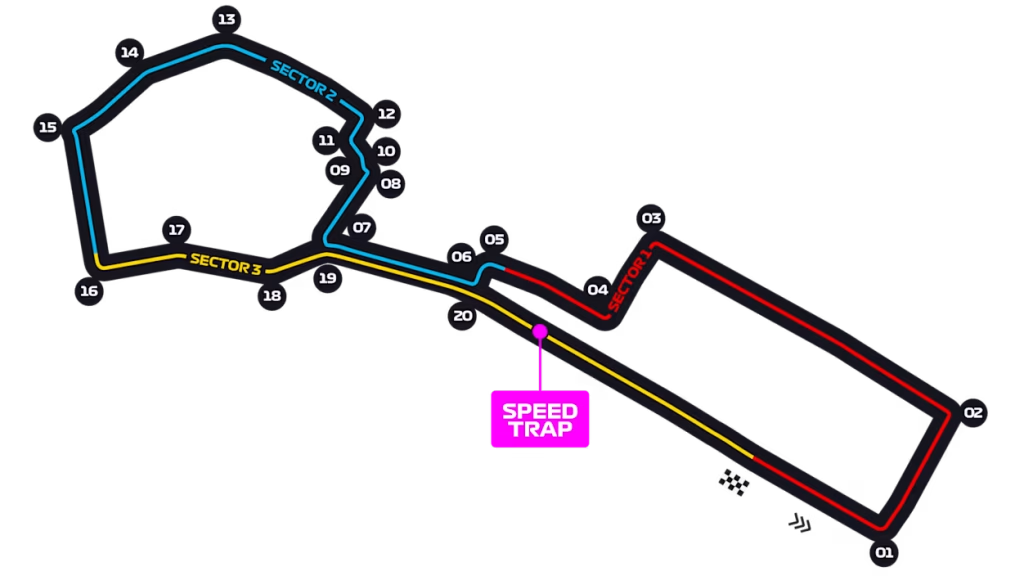
Fans saw it in 2025. Charles Leclerc carried too much speed toward the corner and crashed his Ferrari. Later, Norris touched the wall there on the lap that decided his own qualifying position.
After the session, Norris summed up the uncertainty perfectly: “It’s hard to know how much risk to take and this time it didn’t pay off.”
That line should shape his approach in 2026. Norris does not need to win the lap on Turn 15 entry. He needs to survive the braking phase with enough balance to attack the exit.
The distinction matters because Turn 16 feeds the huge acceleration run toward the timing line. Lose traction there, and the mistake follows him for seconds. A slightly conservative entry can actually create a faster lap.
Get the rotation finished, open the steering and smash the throttle earlier. At Baku, patience can be aggressive.
The pit wall has a qualifying job too
Norris can execute every technical detail correctly and still lose time before his flying lap begins.
Traffic matters enormously here. A car ahead can hurt him through the narrow middle sector by disturbing the airflow, yet that same car can become valuable when Norris reaches the long straight and catches its slipstream.
The gap has to be almost perfect. Too close and he compromises tyre preparation or cornering grip. Too far away and the tow disappears when he needs it most.
A massive chunk of Norris’s Saturday success will therefore come down to the pit wall’s timing. McLaren must release him with enough room to prepare the tyres properly without leaving him isolated when the slipstream starts to matter.
The 2025 qualifying session showed how quickly those plans can collapse. Red flags repeatedly destroyed preparation laps, cooled tyres and turned Q3 into a race against the clock. McLaren tried to bank laps before another stoppage could arrive, but that approach carried its own risk.
Track evolution, changing grip and traffic can make the final minutes dramatically quicker. Send Norris early, and he gains protection from another red flag. Leave him late, and he might find a faster circuit but never complete the lap.
The pit wall cannot drive Turn 15 for him. It can make sure he reaches Turn 15 with the right tyres, the right gap and enough time remaining to attack.
A banker lap could become more valuable than a heroic final run
Baku rarely promises drivers a clean Q3.
Six red flags in 2025 provided the obvious warning. One mistake elsewhere can erase an entire tyre preparation cycle, leave a driver sitting at pit exit and turn his final attempt into a frantic dash toward the line.
Norris should treat his first serious Q3 lap accordingly. Instead of assuming the second run will deliver the perfect track, he needs a competitive banker early. That does not mean cruising. It means producing a lap capable of protecting a front-row challenge if the session suddenly stops.
Hungary showed he can handle that pressure. Hamilton held provisional pole before Norris delivered his 1:17.207 on the final runs. Twelve thousandths separated them, yet Norris found enough without turning the lap into a sequence of desperate corrections.
That composure matters more at Baku than raw aggression. One yellow flag can erase everything.
Baku can reveal whether Norris’s Saturday weakness has become a weapon
By the time Formula 1 reaches Azerbaijan, the championship picture may look different again. Antonelli currently owns the advantage, Norris has ground to recover, and McLaren still has races before Baku to understand its upgraded car and sharpen the balance that finally came alive in Hungary.
The Azerbaijan test already looks clear. Lando Norris’s qualifying pace at Baku will depend on compromise rather than domination. McLaren cannot give him maximum grip through the Castle Section and maximum efficiency down the straight at the same time. Norris cannot attack every braking zone at the absolute limit without eventually discovering where the wall begins.
The trick will be choosing where the lap truly matters. Protect enough tyre temperature for Turn 1, keep the rear calm through the Old City and leave Turn 15 with traction instead of smoke. Use the tow when it appears, then bank a lap before Baku’s chaos gets another vote.
Norris has failed to put all of those pieces together here before. In 2024, qualifying buried him in the midfield while Piastri showed what the McLaren could do from the front row. In 2025, Norris arrived at Q3 with pole-level potential and left seventh after one untidy final lap.
Now the context has changed. Spa showed he could pull an exceptional lap from the car, while Hungary proved he could turn that speed into pole and then into victory. The gap to Antonelli means those Saturdays cannot remain occasional flashes.
Before long, Norris will leave Turn 16 in Baku and bury the throttle. The steering wheel will settle, the walls will blur, and his tyres will cool while the speed climbs. Then Turn 1 will rush toward him.
At that point, qualifying pace at Baku will stop being an engineering discussion or a championship talking point. It will become a question of feel, nerve and a few metres of asphalt, where one tenth can separate the front row from traffic, and one mistake can end the session against concrete.
Norris does not need the wildest lap. He needs the cleanest fast one.
READ MORE: Why Tire Warm-Up Could Decide the Azerbaijan Grand Prix
FAQs
Why is qualifying so important for Lando Norris at Baku?
A poor grid position puts Norris into traffic and removes strategic control. His 2024 recovery showed that strong race pace cannot completely erase a bad Saturday.
What makes Baku qualifying difficult for Lando Norris?
Cold front tyres, heavy braking zones, narrow walls and the downforce-versus-drag compromise leave Norris almost no margin for error.
How much can tyre temperature drop before Turn 1 at Baku?
Pirelli data cited in the article says front-axle temperatures can fall by roughly 40°C during the long run toward Turn 1.
Where can Lando Norris gain qualifying time at Baku?
He can gain time through cleaner Turn 1 braking, calm execution through the Castle Section and stronger traction leaving Turn 15.
Why does McLaren need to compromise its Baku setup?
More downforce improves grip through Baku’s tight corners, while less drag boosts straight-line speed. McLaren cannot maximise both at the same time.

