


The Baku dirty-air challenge starts with another rear wing filling the visor and the speed climbing beyond 300 km/h. Tucked into the slipstream along the Caspian waterfront, a driver gains ground almost for free. Then the straight ends. Cold front tyres, shifting aerodynamic balance and the Turn 1 braking zone arrive together, with concrete and runoff waiting beyond.
Formula 1 rewrote its aerodynamic rulebook for 2026 partly to make that pursuit less punishing. Smaller cars, revised wake-control devices, flatter floors and active wings should help drivers follow more closely. Engineers have attacked dirty air from several directions, but Baku will ask whether those ideas survive outside the wind tunnel.
Following another car here requires far more than hanging onto its gearbox. Drivers must preserve enough front-end confidence to brake late, rotate the car and launch another attack. Lose a little grip in the wrong place and the advantage of the tow disappears immediately.
Baku offers something few circuits can provide: a violent real-world examination of Formula 1’s new aerodynamic philosophy.
Baku Turns Aero Theory Into a Street Fight
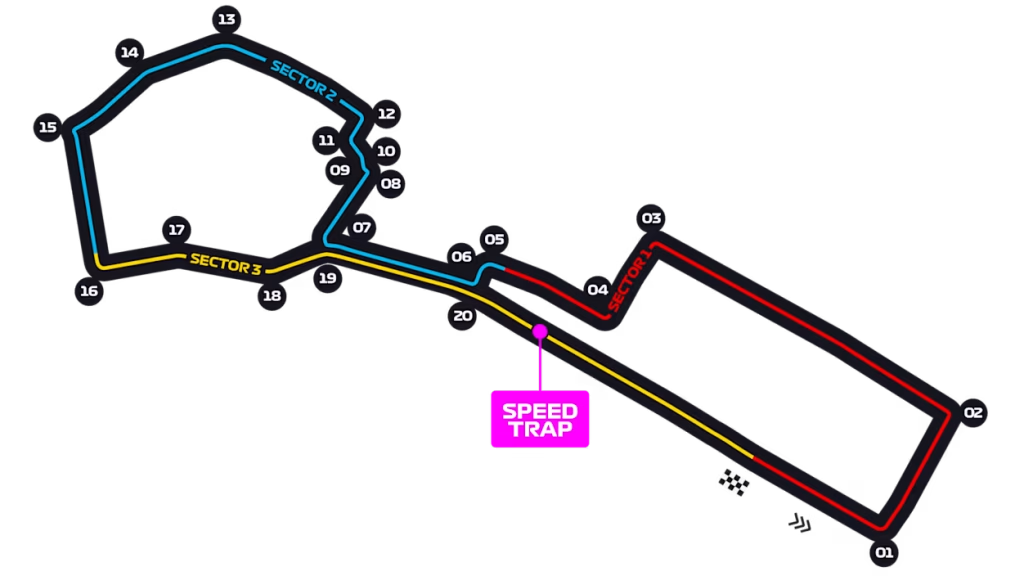
The Baku City Circuit stretches 6.003 kilometres around 20 corners, but the lap behaves like several different tracks welded together. The waterfront rewards low drag. The opening sector demands repeated heavy braking. Then the Old City compresses the circuit to just 7.6 metres at its narrowest point. Formula 1 also measures only 141 metres from pole position to the Turn 1 braking point, the shortest such run on the calendar.
Those contrasts sharpen the Baku dirty-air challenge. On a conventional track, a driver can sometimes tolerate understeer in the wake and wait for a better corner. Baku rarely offers that luxury because another braking zone, concrete barrier or traction point arrives before the car settles.
By the time a driver catches the car ahead, turbulent airflow can strike precisely when braking stability matters most.
Formula 1 has spent decades trying to reduce that penalty. The 2009 aero reset stripped away much of the aerodynamic complexity that had accumulated through the previous era. Eight years later, the wider 2017 cars pushed downforce and grip sharply upward again. The 2022 regulations then brought ground effect back as part of a package designed specifically to let cars follow more closely.
For 2026, Formula 1 has changed the approach again. Ground-effect dependence has fallen, the cars have become smaller, and regulators have reworked how airflow moves around the wheels and wings.
A computer can predict the wake. Baku decides whether a driver trusts the car inside it.
Active Aero Makes the Chase Faster and Harder
The new active front and rear wings do much of the visible work in 2026. They hold a higher-downforce position in Corner Mode, then flatten in Straight Mode to shed drag and reduce energy consumption.
After Turn 16, that concept fits Baku almost perfectly.
The car explodes onto the waterfront run. A chasing driver reduces drag, catches the slipstream and watches the gap collapse. The most revealing part of the Baku dirty-air challenge comes a few seconds later, when the straight ends. The wings return toward their cornering configuration, the driver attacks the brake pedal, and the front tyres suddenly have to deliver.
Straight-line speed means very little if the car refuses to bite.
Formula 1 has also made the machinery easier to place. The maximum wheelbase dropped by 200 millimetres to 3.4 metres, while the chassis and floor became narrower. Front tyres lost 25 millimetres of width, and the rears lost 30. Minimum weight also fell to 768 kilograms.
Those figures sound clinical until two drivers reach Turn 1 together.
A smaller car leaves more usable asphalt, and lower weight should improve agility. Neither change guarantees a stable front axle after several seconds inside another machine’s disturbed airflow.
Mercedes deputy technical director Simone Resta offered a useful warning when discussing the new regulations with the FIA, describing the resulting racing as “different and potentially quite more unpredictable.” He pointed specifically to the interaction between movable aerodynamics and electrical energy management.
Baku seems built to expose exactly that uncertainty.
Overtake Mode Makes Backing Away Expensive
Drivers now have another reason to stay attached.
Under the 2026 rules, Overtake Mode becomes available when the pursuing car reaches the detection point within one second of the driver ahead. The system offers additional electrical energy and a stronger deployment profile for the attack.
That changes how a driver manages the gap. Back away far enough to recover clean airflow and the Overtake Mode opportunity can disappear. Sit too close through the wrong sequence and front-end wash may ruin the corner exit required to launch the pass.
The quickest approach may involve deliberately surrendering a few metres.
A smart driver can give the front wing cleaner air through a sensitive corner, then close again where the tow becomes powerful. Every instinct inside the cockpit says attack, but patience may create the better attack.
Over a stint, those tiny choices accumulate.
Cold Tires Turn Turn 1 Into a Guessing Game
Baku’s longest blast does more than create a tow. It changes the tyre underneath the driver.
In its official preview for the 2025 Azerbaijan Grand Prix, Pirelli reported that front-tire surface temperatures could sit around 90 degrees Celsius before the long run beginning at Turn 16. By the end of that section, the company estimated a drop of as much as 40 degrees. Pirelli specifically highlighted qualifying, wheel-to-wheel racing and Safety Car restarts as moments when drivers could feel the effect.
The 2026 tyres have different dimensions, so those exact measurements cannot simply be transferred to the new cars. The basic threat remains.
Drivers spend a long stretch with little steering load before arriving at one of the largest braking demands on the lap. A slipstream raises the approach speed. Dirty air adds uncertainty around the front axle.
The Baku dirty-air challenge becomes a prediction exercise at enormous speed.
Move out of the tow too early and drag weakens the attack. Stay tucked behind the leader for another heartbeat, and the car reaches Turn 1 faster, perhaps with cooler front tyres and less aerodynamic stability than expected.
Brake early and the chance disappears. Brake a fraction too late, and the escape road suddenly looks very small.
The Old City Punishes Nervous Cars
The castle section strips away Baku’s illusion of space. Stone walls and barriers crowd the driver’s peripheral vision, while the racing line squeezes through the 7.6-metre pinch point.
No simulation can fully reproduce the emotional cost of that confinement.
A following driver may lose front grip just as the leader occupies the cleanest piece of asphalt. There is no generous runoff area waiting to rescue an optimistic line. Lift,t and the gap grows. Force a reluctant front axle toward the apex and the wall becomes part of the calculation. Daniel Ricciardo, the 2017 Baku winner, once captured the required mindset perfectly: “You have to love it, but you also have to respect it.” In traffic, that respect becomes an aerodynamic decision as much as a psychological one.
The Baku dirty-air challenge rewards consistency more than spectacular peak downforce. Engineers can produce a car that looks exceptional in clean air. A driver needs one that responds predictably after another car has shredded the airflow reaching its front wing.
Turn 15 provides a brutal reminder.
During 2025 qualifying, Charles Leclerc carried too much speed into the downhill left-hander, encountered low grip, locked the tyres and hit the barrier. His accident produced the fifth red flag in a session that eventually reached an F1-record six stoppages.
Leclerc did not need dirty air to discover how quickly Baku can punish uncertainty. Put another rear wing in front of the driver, and the margin shrinks further.
Track Position Starts Winning Before the Pass
Baku produced 66 overtakes during the 2024 Azerbaijan Grand Prix, an eye-catching total for a street circuit. Formula 1’s published statistics do not split those moves into DRS-assisted and non-DRS categories, so the raw number needs context.
The circuit supplies it.
The main straight and Turn 1 form Baku’s most obvious passing zone. Drivers survive the technical sections, maximise the Turn 16 exit and use the tow to launch themselves toward the braking point. The harder question concerns what happened to the tyres and front wing during the lap spent following.
A driver can lose the race before completing the overtake.
Several laps of front-end wash behind a slower car can start degrading the tyre platform. Television may later make a pit stop look decisive, while engineers tracing the data can find the real time loss several laps earlier in traffic.
Clean air therefore becomes a strategic asset in the Baku dirty-air challenge.
An aggressive undercut can make sense before tyre life demands it if the stop opens a pocket of empty asphalt. Extending the stint carries its own appeal when rivals have rejoined inside a train of cars.
Fresh rubber matters. Being able to use it matters more.
Twenty-Two Cars Squeeze the Strategy Window
Cadillac’s arrival expanded Formula 1 to 11 teams and 22 cars in 2026, returning the championship to a grid size it had not seen since 2016.
At Baku, those two extra cars alter far more than the overtaking count.
Qualifying becomes busier as drivers search for clear track, prepare their tyres and hunt useful slipstreams. Pit windows tighten because open asphalt becomes harder to find. Leaders can also reach traffic sooner, creating situations where one driver follows another while both close on a third car.
The Baku dirty-air challenge can quickly become a chain reaction.
The leader changes line. The pursuer reacts to the wake. A third driver sees an energy opportunity and closes from behind. Three cars can arrive at the same braking zone with different tyre temperatures, different aerodynamic balance and different reasons to attack.
Safety Car restarts compress everything further. Twenty-two cars bunch together, front tyres cool and drivers weave for temperature while trying to judge the restart. When the leader accelerates, the entire field funnels toward Baku’s opening sequence with almost no breathing room.
Five seconds of clean track may prove more valuable than five extra laps of theoretical tyre life.
Baku Will Expose What Formula 1 Really Fixed
The 2026 Azerbaijan Grand Prix runs from September 24 to 26, with the race scheduled for Saturday, September 26. The unusual Saturday slot is deliberate rather than a calendar error. The FIA and Formula 1 moved the Grand Prix following a request from the promoter and Azerbaijani government stakeholders to accommodate a national day.
By then, teams will have spent months understanding the new generation of machinery. Engineers will know their active-aero maps. Drivers will understand Overtake Mode. Strategists will have studied electrical deployment and tyre behaviour across almost every type of circuit.
Baku can still make all of that knowledge feel incomplete.
A driver must chase the tow without surrendering the front tyres. The car has to remain stable when the airflow changes and decisive when the braking zone arrives. Sometimes the quickest route forward will require creating a little space first, even with another car threatening from behind.
The Baku dirty-air challenge lives inside that balancing act.
Formula 1 has changed the wings, floor, tyres, dimensions and energy systems in pursuit of better racing. Clean-air lap time will tell engineers whether the cars are fast. Baku will tell everyone something more important: whether they can remain fast when another car occupies the road ahead.
The real test begins when two of them reach Turn 1 together.
The pursuing driver feels the tow disappear, leans into the brake pedal and turns toward the concrete. Years of regulation meetings and aerodynamic simulations become irrelevant in that instant.
Only the front tyres get to answer.
READ MORE: What Azerbaijan Grand Prix Strategy Could Mean for Charles Leclerc
FAQs
Why is dirty air such a problem at Baku?
Dirty air can reduce front grip while drivers follow closely. Baku makes that dangerous because long straights feed directly into heavy braking zones.
How does Active Aero work on 2026 F1 cars?
The wings reduce drag on designated straights and return to a higher-downforce configuration for corners, helping balance speed with grip.
Why can front tyres cool so much at Baku?
Drivers spend a long time with little steering load on the waterfront straight. That can cool the front tyres before the heavy Turn 1 braking zone.
How many Formula 1 cars race in 2026?
The 2026 grid has 22 cars across 11 teams following Cadillac’s arrival.
When is the 2026 Azerbaijan Grand Prix?
The Baku weekend runs from September 24 to 26, 2026. The Grand Prix takes place on Saturday, September 26.

Exploring sport through timely updates, informed insights, compelling stories, and wider discussion.
