


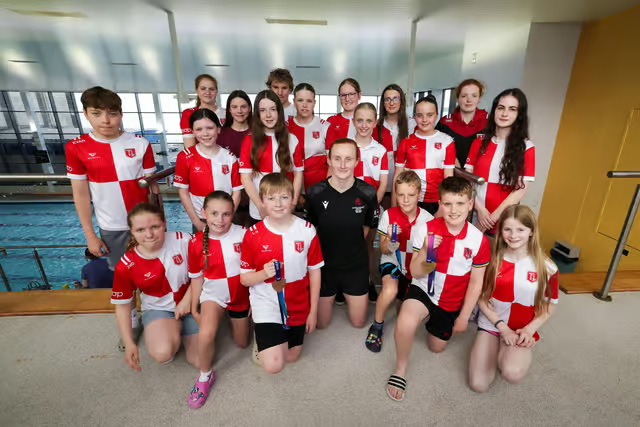
At Larne Leisure Centre, young members of Larne Swimming Club got an early look at the Glasgow 2026 Commonwealth Games medals as the Medal Tour arrived in Northern Ireland. Hill, a development-squad coach at the club and one of Team NI’s most experienced swimmers, stood at the center of a scene that carried more weight than a standard games promotion.
The medals were the draw. Hill was the reason the moment landed. She first competed at the Commonwealth Games in Glasgow in 2014 as a 14-year-old. Now she is heading back to the same city for her 4th Games, this time with years of international experience behind her and a new generation watching from the poolside.
Larne Gets Its Own Commonwealth Games Moment
There was no stadium noise, no medal ceremony, no broadcast glare. Just the familiar rhythm of a swimming club night: poolside chatter, wet hair, towels over shoulders, and the clean sting of chlorine in the air.
Hill stood in Lirne colors and brought the games down to a scale young swimmers could understand. The silver, gold, and bronze medals were no longer distant objects waiting in Glasgow. They were right there in the hands and eyeline of children still building their strokes, their confidence, and their sense of what the sport might become.
That is what made the visit matter. The Commonwealth Games can feel huge from the outside, with flags, schedules, venues, and selection lists. In Larne, the message became simpler. Someone from these lanes had reached that stage. Someone who still works with young swimmers at the club had gone from local sessions to international finals.
Hill put that link into plain words during the Larne visit.
“Standing here today at the club where my swimming journey began makes this incredibly special. Every athlete’s story starts somewhere and for me it started right here in Larne,” Hill said.
The Medal Is Built To Be Felt
The Glasgow 2026 medal has its own story. Glasgow-based artist Militsa Milenkova designed it with a distinctive rounded-triangular profile, drawing from the city’s landmarks, coat of arms, industrial past, and cultural identity.
Its most important feature is not just visual. The medal includes Braille and tactile surfaces, making inclusion part of the object itself. At a game where para-sport sits inside the main programme, that choice matters. It means the medal does not simply represent achievement. It also reflects who the event is trying to include.
For the Larne swimmers, the details did not need a long explanation. The medals had weight. They had texture. They had the kind of physical presence that turns an abstract ambition into something real.
Young athletes often hear about sacrifice, discipline, and long-term goals. They rarely get to hold the symbol at the end of that process. This visit gave them that chance.
Team NI Has Real Strength Behind The Story
Hill’s homecoming brought warmth, but Team NI is not heading to Glasgow on sentiment alone. The swimming squad has been officially selected, and it carries serious medal potential.
Daniel Wiffen leads the team after becoming one of the biggest names in Irish and Northern Irish sport. Jack McMillan brings Olympic relay gold experience. Hill adds deep Commonwealth Games pedigree and is entered in the 50m freestyle, 50m backstroke, and 100m backstroke.
The Para Swimming group adds more proven quality. Bethany Firth returns as a defending Commonwealth champion in the S14 200m freestyle. Barry McClements, who won bronze at Birmingham 2022, remains a key figure after becoming Northern Ireland’s first Commonwealth medalist in a swimming discipline.
That depth changes how the Larne visit should be read. This was not only about inspiring children with a shiny object. It was also about placing them in the orbit of a team that has already broken barriers in the pool and now wants more.
A Small Club Scene With A Bigger Glasgow Meaning
Glasgow 2026 starts on 23 July and runs through 2 August. More than 3,000 athletes from 74 nations and territories will compete across 10 sports and 6 Para sports, using a tighter Games model built around 4 venues.
Those numbers explain the size of the event. Larne explained its reach.
Major games often sell themselves through scale, but their lasting pull comes from moments like this. A local athlete returns home. A group of young swimmers gathers close. A medal moves from poster to palm. Suddenly, the route from club lanes to Commonwealth selection does not feel like a slogan.
For Hill, the visit tied her past to her present. At Larne Swimming Club, it was recognition of the coaches, volunteers, families and early-morning routines that sit behind every elite career. Meanwhile, for the children watching, Glasgow 2026 became less like a date on the calendar and more like a target they could imagine.
That is the power of taking the medal tour into the community. It does not guarantee the next champion, but it does something more basic and more necessary. It lets young swimmers see that the journey can start exactly where they are.
READ MORE– Olympic Stars And New Faces Lead Team Wales Into The Glasgow 2026 Commonwealth Games
FAQs
Who is Danielle Hill? Danielle Hill is a Team NI swimmer from Larne. She is preparing for her 4th Commonwealth Games at Glasgow 2026.
Why did Danielle Hill bring the medals to Larne? Hill helped bring the Glasgow 2026 medals to Larne Swimming Club as part of the Medal Tour. The visit gave young swimmers a close look at the prize.
What makes the Glasgow 2026 medals different? The Glasgow 2026 medals include braille and tactile surfaces. The design makes inclusion part of the medal itself.
When are the Glasgow 2026 Commonwealth Games? The Glasgow 2026 Commonwealth Games run from 23 July to 2 August. Swimming and Para Swimming will be key parts of the programme.
Why does the Larne medal visit matter? The visit showed young swimmers that elite sport can start in local lanes. Hill’s return made the Commonwealth Games feel close and real.

